You’ve decided you want the sleek convenience of a smart ring to monitor your sleep, recovery, and daily activity. But then you notice the fine print: many of the most popular fitness rings require a monthly subscription to unlock your own health data. That recurring cost adds up quickly—often $6 to $12 per month, or $72 to $144 a year. If you want to avoid that ongoing expense, you need a device that gives you full access without a paywall. This guide walks you through exactly how to select a subscription free fitness ring, what to look for in the hardware, and which features actually matter for daily use.
Key Takeaways
- Subscription-free rings provide full access to sleep, activity, and readiness data without monthly fees, saving you $72–$144 per year.
- The best subscription-free options prioritize battery life, sensor accuracy, and a companion app that doesn’t hide core metrics behind a paywall.
- Before buying, check whether advanced features like workout tracking, SpO2, and skin temperature are included in the base price or locked behind a membership.
- Hardware quality matters more than brand name: look for durable materials, water resistance (at least 5 ATM), and a comfortable fit for 24/7 wear.
- Compare your paid-subscription alternatives carefully—some charge for premium insights, while others require a paid plan just to see basic sleep stages.
Why Choose a Subscription-Free Fitness Ring?
Fitness rings are compact, comfortable, and less distracting than a smartwatch. They track your steps, heart rate, sleep stages, and sometimes even skin temperature. However, the subscription model has become common in this category. When you buy a ring from a company that charges for its app, you are essentially purchasing hardware that only works at full capacity if you keep paying. Over a two-year period, that subscription can cost more than the ring itself.
A subscription-free fitness ring, on the other hand, puts you in control. You pay once for the device, and every metric the sensors capture is available in the app—no hidden fees, no trial periods that expire, and no feeling like your data is being held hostage. For many users, this is not just about saving money; it’s about ownership. You bought the hardware, and the data it collects should belong to you.
Beyond the cost, there is also the simplicity factor. A subscription-free ring does not require you to remember renewal dates, manage account settings, or worry about what you lose if you decide to cancel. It works as a straightforward tool, which is exactly what a fitness tracker should be. If you’re looking for a reliable option that respects your wallet, start by exploring a subscription free fitness ring that has transparent pricing and a feature-rich app included at no extra charge.
What to Look for in a Subscription-Free Fitness Ring
Not all subscription-free rings are created equal. Some companies advertise “no subscription” but then limit the app’s functionality, requiring you to export data to third-party platforms to see useful trends. Others offer a basic free tier but make premium insights—like readiness scores or detailed sleep breakdowns—paid. Your goal is to find a ring where the core experience is genuinely complete without any upsell.
Battery Life and Charging
Because a ring is worn 24/7, battery life is critical. Most good subscription-free rings offer between 5 and 7 days of battery life on a single charge. Anything less than 4 days becomes inconvenient because you are constantly thinking about when to charge it. Look for a ring that comes with a portable charging case, which allows you to recharge on the go without carrying a cable. Also, consider how long a full charge takes—shorter is better, ideally under 90 minutes.
Sensor Accuracy and Data Quality
The main reason to buy a fitness ring is to get accurate health data. The three core sensors to evaluate are the optical heart rate sensor, the accelerometer (for movement), and the skin temperature sensor (if included). Check whether the ring supports daytime heart rate tracking, resting heart rate measurement, and automatic sleep stage detection. Some budget rings only measure movement and sleep duration—not actual sleep stages. If you want quality data, make sure the device tracks light, deep, and REM sleep automatically without you having to start a timer.
App Experience Without a Paywall
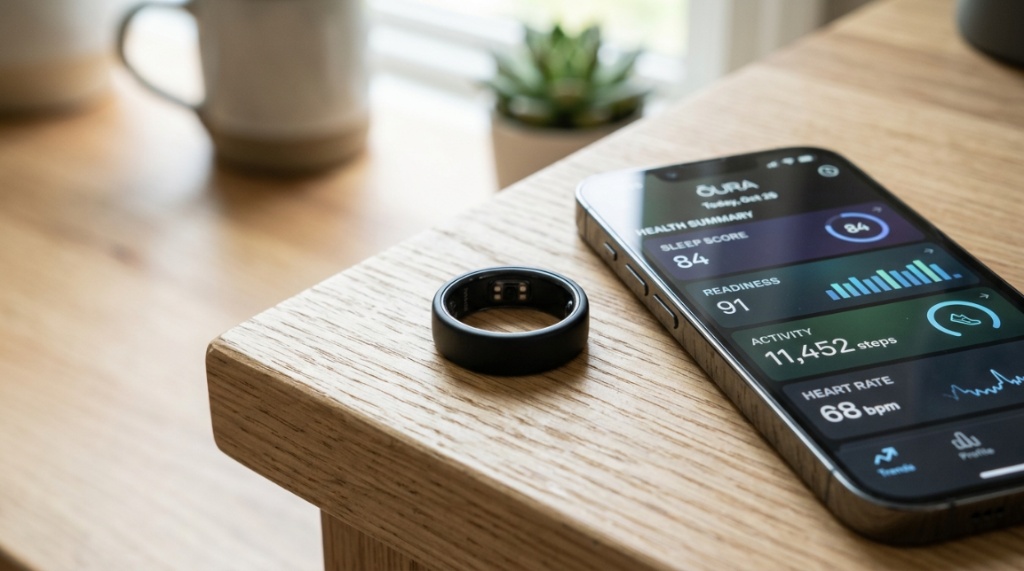
The app is where you will interact with your data, so it needs to be intuitive and complete. Before purchasing, download the companion app (most are free to browse) and check which features are visible. Look for the sleep score, activity trends, heart rate variability (HRV), and resting heart rate. If these are visible in the app even before you pair a device, that’s a good sign. If the app requires a premium membership to see even the basic dashboard, avoid that product.
To ensure your setup supports high-impact workouts and protects your equipment, read our guide on how to choose the right gym flooring for sports.
Comparing Subscription-Free Rings vs. Paid-Subscription Rings
To make an informed decision, you need to understand what you are actually giving up (or gaining) by choosing a subscription-free option. Here is a side-by-side look at the trade-offs.
| Feature | Subscription-Free Ring | Paid-Subscription Ring |
|---|---|---|
| Upfront Cost | Higher (typically $200–$350) | Lower (often $150–$300) |
| Monthly Fee | $0 | $6–$12/month |
| Sleep Tracking | Full sleep stages and scores included | Basic sleep duration may be free; detailed stages often require subscription |
| Readiness/Recovery Score | Typically included | Often a premium feature |
| HRV & Resting HR | Included | Sometimes included, sometimes paywalled |
| Long-Term Cost (2 Years) | $200–$350 total | $344–$588 total |
| Data Ownership | Full access, no restrictions | Access disappears if you cancel subscription |
As the table shows, the subscription-free ring usually costs more upfront, but it becomes the cheaper option within 12 to 18 months depending on the subscription price. More importantly, you never lose access to your historical data. That is a significant advantage if you like to review your trends over months or years, or if you share data with a doctor or coach.
Key Features That Should Be Free by Default
When you evaluate a subscription-free fitness ring, confirm that the following features are available without any add-on purchase. If a product charges for these, it does not truly qualify as subscription-free in spirit.
- Sleep staging: You should be able to see your time in light, deep, and REM sleep, plus a sleep score.
- Heart rate data: This includes resting heart rate, HRV, and continuous daytime heart rate graphs.
- Activity tracking: Steps, calories, active minutes, and distance should be visible in the app.
- Goal setting: You should be able to set daily activity and sleep goals, and receive nudges when you meet them.
- Historical data export: You should be able to export your raw data (CSV or similar) at any time.
- Firmware updates: Software updates that improve accuracy or add features should be free for the life of the device.
Which Sensors Actually Matter for Daily Use?
Fitness rings pack a lot into a small space, but not all sensors are equally useful. Here is what you should pay attention to rather than getting distracted by marketing buzzwords.
Optical Heart Rate Sensor
This is the foundation of any fitness tracker. It measures your pulse by shining light through your skin. A good optical sensor is especially important for sleep tracking because your heart rate and HRV during sleep are key indicators of recovery. Check if the ring uses a multi-wavelength sensor (green and red LEDs) for better accuracy across different skin tones and in low-light conditions.
Accelerometer
This sensor detects movement and is used for step counting and sleep position analysis. It is equally important for recognizing when you are awake versus asleep. A high-quality accelerometer helps the ring automatically detect naps and overnight movement patterns. There is not much you need to evaluate here beyond general reputation—most modern rings use reliable accelerometers.
Skin Temperature Sensor
Not every ring has this, but it is becoming more common. Skin temperature can help you detect early signs of illness, track menstrual cycles, and understand how your body reacts to late meals or alcohol. This sensor is a nice-to-have, not a must-have, unless you have specific health monitoring needs. If a ring includes it, make sure the temperature trend data is displayed in the free app—some brands make this a premium feature even on subscription-free models.
Common Mistakes to Avoid When Buying a Fitness Ring
Even when you know to avoid subscriptions, there are other pitfalls that can lead to buyer’s remorse. Being aware of these before you buy will save you time and money.
Ignoring Sizing and Fit
Fitness rings need to fit snugly for accurate sensor readings, but not so tight that they leave marks or cause discomfort. Most brands offer a free sizing kit that lets you try plastic sample rings for a few days. Do not skip this step. A ring that is too loose will have fluctuating heart rate readings; a ring that is too tight can interfere with circulation and sleep quality.
Overlooking Water Resistance
If you swim, shower with your ring, or sweat heavily during workouts, you need a ring with at least 5 ATM water resistance. This rating means it can withstand pressures equivalent to 50 meters of depth. Some rings are only splash-proof, which is fine for hand washing but not for swimming. Check the IP or ATM rating carefully.
Assuming All Rings Fit All Fingers
Rings have a specific sensor placement on the underside. For the sensor to read your pulse accurately, the ring must be worn on the index or middle finger. The sensor must sit flush against the skin. If you prefer wearing rings on your ring finger, accuracy may suffer. Test the ring on the recommended fingers during your sizing trial.
How to Verify a Ring Has No Hidden Subscription
Before you check out, take a few steps to ensure the product is truly subscription-free. Some companies sneak in “premium features” that require a monthly fee after the first 90 days. Here is how to avoid that surprise.
- Read the product description carefully: Look for phrases like “no subscription required,” “all features included,” or “no hidden fees.” If the description is vague about the app cost, send a message to customer support asking specifically about monthly fees.
- Check the app store listing: Search for the companion app on the Apple App Store or Google Play Store. Look at the “In-App Purchases” section. If you see a monthly subscription listed, that is a red flag—unless the subscription only applies to optional features that you can ignore.
- Search for recent user reviews: Look at reviews from the last few months, not just launch-day reviews. Users often post honest feedback when a company introduces a subscription after purchase.
- Review the company’s privacy policy and terms of service: This is tedious, but it will reveal any mention of paid subscription tiers. Companies must disclose this in their legal documents.
Is a Subscription-Free Ring Worth It Long Term?
For most people, yes. The initial purchase price may be slightly higher, but the savings over time are undeniable. If you are someone who likes to track health data consistently for more than a year, a subscription-free ring is almost always the more economical choice.
There are two situations where a subscription ring might make sense. First, if you want to try a ring for just a few months and don’t mind canceling, the lower upfront cost could be attractive. Second, if a particular subscription-based ring has a sensor or feature that is significantly better than any subscription-free alternative, paying the monthly fee might be worth it for your specific health needs. But for the average user who wants reliable sleep and activity tracking without ongoing costs, the subscription-free route is the smarter financial decision.
Additionally, subscription-free rings tend to have a longer useful life. Since you already paid for the device, you are more likely to keep wearing it and caring for it, rather than abandoning it after a year to avoid the fee. Consistency is the most important factor in getting useful health data, and removing the subscription friction helps you stay consistent.
Frequently Asked Questions
Do subscription-free fitness rings have worse sensors?
No. Sensor quality depends on the specific brand and model, not on whether the company charges a subscription. Some subscription-free rings use the same optical sensors found in premium subscription-based competitors. The key is to check specifications like the number of LEDs, the sampling rate, and independent user reviews on accuracy.
Can I use a fitness ring without a smartphone?
No. All fitness rings require a smartphone to set up the device, sync data, and view detailed analytics. The ring itself has no display. You need a compatible iOS or Android device with Bluetooth and the manufacturer’s app installed. A fitness ring is not a standalone device.
How long do fitness ring batteries last before needing replacement?
Most fitness rings have a lithium-ion battery that lasts 2 to 3 years before noticeable capacity degradation. After that, you may need to charge more frequently. The ring itself is generally expected to last 3 to 5 years, depending on build quality and how well you maintain it. You cannot replace the battery in most models—it is sealed inside the ring body.
Are subscription-free rings compatible with Apple Health and Google Fit?
Most reputable brands offer integration with Apple Health, Google Health Connect, or both. This allows you to sync your ring data to your preferred health dashboard. Check the product specifications before buying, because data integration is not universal across all budget brands.
What happens to my data if the ring company goes out of business?
If you choose a subscription-free ring, your data is stored locally on your phone and synced to the app. Even if the cloud service is discontinued, you can typically still export your data via CSV. With a subscription-based ring, if the service shuts down, you lose access to the app and your data entirely. This makes subscription-free rings a safer choice for long-term data ownership.
Conclusion
Selecting the right fitness tracking ring comes down to understanding what you are paying for over the life of the product. A subscription-free fitness ring gives you complete ownership of both your hardware and your health data, without the constant pressure of a monthly fee. When comparing models, focus on battery life, sensor quality, app completeness, and water resistance. Avoid the common mistakes of skipping the sizing kit or assuming all rings are water-safe. Above all, confirm that the app you will use daily displays every metric you care about—sleep stages, heart rate, HRV, and activity—without any hidden paywall. By putting in a little research now, you can choose a ring that serves you for years, costs less over time, and never asks for a credit card update.