Key Takeaways
- A clinical trial is a personal choice that should never be made under pressure.
- Ask about the study’s purpose, risks, possible benefits, and time requirements.
- Learn whether treatment is assigned at random and whether a placebo or standard care may be used.
- Discuss insurance, travel, payment, privacy, and the right to leave before enrolling.
- Informed consent is an ongoing conversation, not simply a form to sign.
Being invited to join a clinical trial can bring hope, uncertainty, and a long list of practical questions. You may be managing a diagnosis, considering a new treatment path, or looking for ways to contribute to medical research. Whatever brings you to the conversation, the decision deserves time and clear information.
A clinical trial is not automatically the right choice for every person, and declining one is not a failure to pursue care. The goal is to understand what participation could mean for your health, routine, finances, and comfort level, then decide with support from your health care provider and people you trust.
Why Questions Matter Before Enrollment
Clinical research can feel unfamiliar, especially when appointments include new medical terms, detailed schedules, and consent documents. Asking direct questions helps transform a confusing discussion into one you can evaluate. It also gives the study team a chance to explain the details in plain language rather than assuming you already understand them.
The clinical trial participation guidance from the U.S. Food and Drug Administration emphasizes that participation is voluntary and that informed consent occurs before enrollment. Use that principle as a starting point: you are allowed to pause, ask for clarification, and take the information home before making a decision.
Learn the Basic Facts About the Study
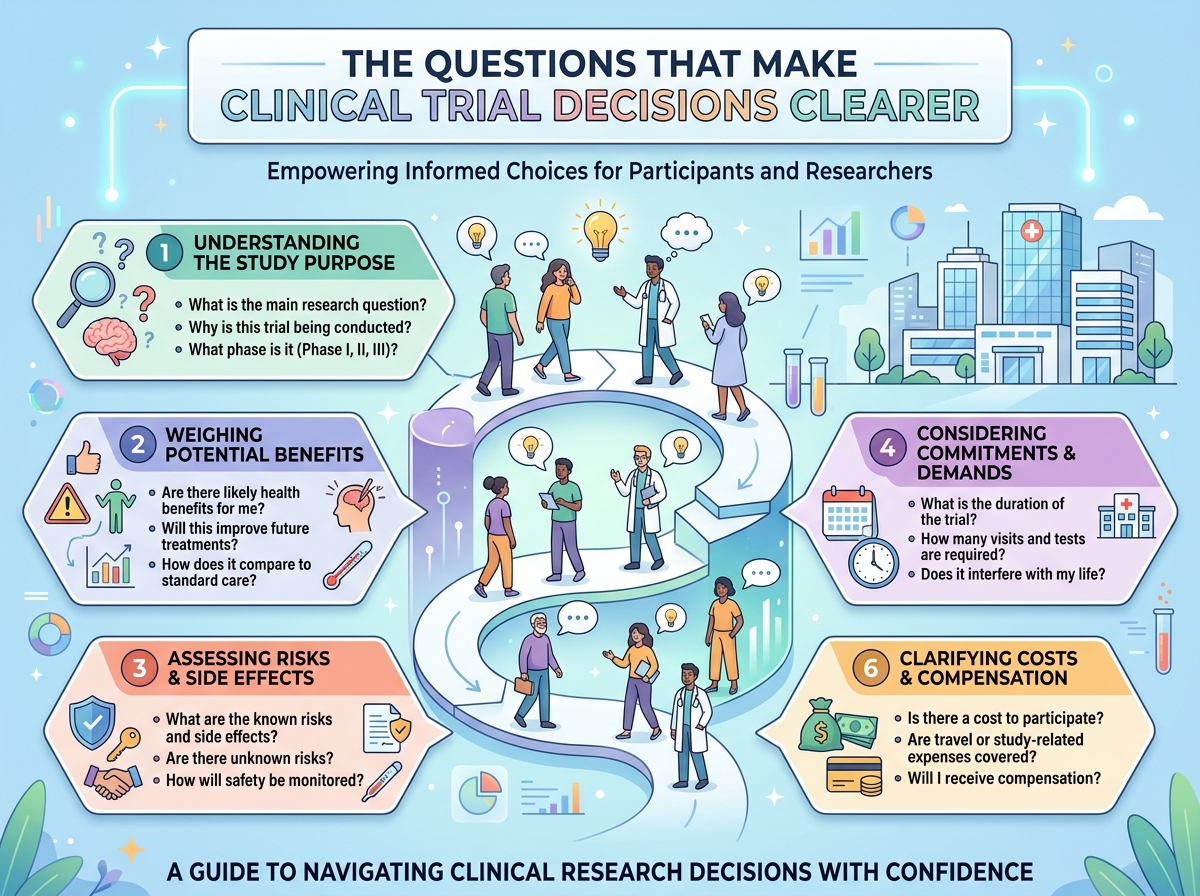
Start with the overall purpose. A study may be testing a medicine, device, procedure, diagnostic approach, or method of monitoring a condition. Understanding the central research question helps you see how the trial fits, or does not fit, with your own treatment goals.
Questions to Ask First
- What is the main purpose of this study?
- What phase is the trial in, and what does that phase mean?
- How many people are expected to participate?
- How long will participation last?
- What visits, tests, medicines, or procedures are required?
- What happens if I do not qualify or become ineligible later?
The study phase can provide a useful context. Earlier studies often focus on safety or dose, while later studies may compare an investigational option with standard care. Still, no phase can guarantee that a treatment will help an individual participant.

Ask About Risks, Benefits, and Uncertainty
Every study has unanswered questions, which is why research is ongoing. Ask the team to describe known side effects, serious but less common risks, and any remaining uncertainties. A possible benefit may exist, but it should not be presented as a promise.
Questions About Medical Effects
- What risks are known so far, and which risks are still uncertain?
- Which symptoms should I report immediately?
- Could participation change or interrupt my current treatment?
- What benefits are reasonably possible for me?
- What standard treatment or other care options are available instead?
- Who do I contact if I have a problem outside normal office hours?
Bring a support person if possible, or ask whether you can record notes for your own use. It is reasonable to request a simpler explanation of unfamiliar terms before you agree to anything.
Check How the Trial May Affect Daily Life
The practical demands of a trial can matter as much as the medical details. Some studies involve frequent blood draws, scans, diaries, home monitoring, calls, or long clinic visits. A schedule that looks manageable on paper may be difficult when combined with work, school, caregiving, or transportation needs.
- How often are appointments, and how long does each one take?
- Can any visits happen by phone or video?
- Will I need to travel, stay overnight, or arrange childcare?
- Can I continue working, exercising, or taking care of family responsibilities?
- What happens if illness, travel, or an emergency causes me to miss a visit?
Understand Treatment Assignment
In some trials, participants do not choose the treatment they receive. The assignment may be random, meaning a computer assigns participants to groups. Depending on the design, you may receive the investigational treatment, standard care, or a placebo.
Ask whether you and your doctor will know the assignment, how likely each assignment is, whether current medicines can continue, and what care every group receives. A placebo does not mean you will be ignored, but you should understand how symptoms, changes in your condition, and urgent needs will be addressed.
Discuss Costs, Coverage, and Payment
Money questions should be discussed before signing a consent form. The sponsor may cover study-related items, while routine medical care could be billed to insurance. Coverage can differ by plan, location, and the services involved.
- Which tests, visits, and treatments are paid for by the study?
- Will insurance be billed for any routine care?
- Could deductibles, copays, parking, meals, or lodging create out-of-pocket costs?
- Is reimbursement offered for travel, time, or expenses?
- When is payment made, and what happens if I leave early?
Ask for cost and payment details in writing. A financial counselor, insurer, or patient navigator may also help you understand the practical impact before enrollment.
Ask How Privacy and Data Are Protected
Research may involve medical records, lab results, scans, surveys, genetic information, or stored samples. Ask what will be collected, who can review it, whether samples may be kept for future research, and how identifying information will be protected. You should also ask whether any data collection is optional.
Know Your Consent and Withdrawal Rights
Informed consent means learning about the study, considering its risks and requirements, asking questions, and choosing whether to participate. It continues throughout the trial. You can raise new concerns at any point and may choose to leave, although the team may recommend a final visit or follow-up steps for safety.
The questions patients can discuss with a clinical trial team can help you prepare for conversations about alternatives, safety, and the possible reasons to participate. Before enrolling, ask how leaving could affect regular care and what happens to information already collected.
Use a Simple Decision Checklist
- Write down the study goal. Describe the research question in one or two sentences.
- List known risks and unknowns. Separate common effects from serious concerns.
- Map the time commitment. Include visits, travel, tests, and home tasks.
- Confirm the financial details. Request a written explanation of costs and payment.
- Compare your options. Discuss standard care, another study, or waiting with your doctor.
- Take time to decide. Talk with someone you trust and return with follow-up questions.
Make a Decision That Fits Your Needs
A thoughtful clinical trial decision should reflect your health goals, values, schedule, and tolerance for uncertainty. Direct questions can reveal both the opportunities and the demands of participation. Whether you choose to enroll, wait, or pursue another care option, an informed decision feels clear, voluntary, and right for you.