Key Takeaways
- A successful slip and fall claim generally requires proof of duty, breach, causation, and damages.
- The condition that caused the fall, such as liquid, ice, damaged flooring, or poor lighting, should be identified as specifically as possible.
- Evidence that the responsible party knew, or reasonably should have known, about the hazard can be central to the claim.
- Photos, surveillance footage, incident reports, witness statements, and medical records may all be important.
- Delay can make evidence harder to find and may affect important legal deadlines.
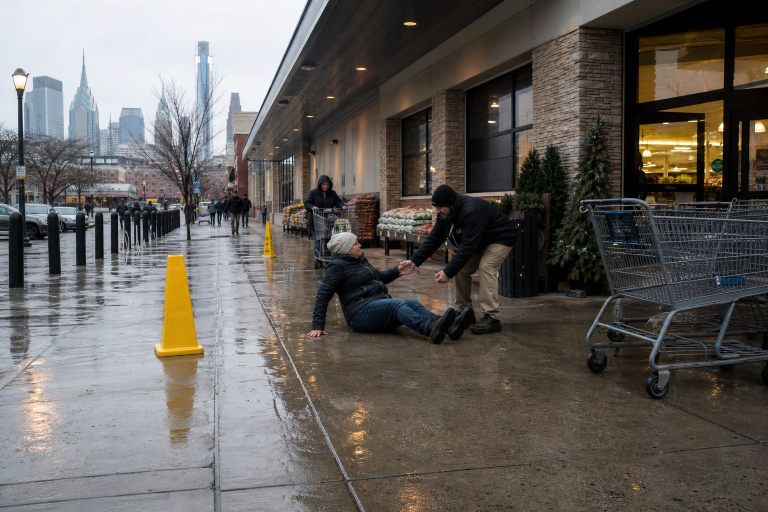
A slip and fall can happen in seconds, whether it occurs on a rainy Philadelphia sidewalk, near a supermarket entrance, in an apartment stairwell, or on an icy parking lot. But a fall alone does not automatically establish a legal claim. A person pursuing a Pennsylvania premises-liability claim generally needs evidence showing that a property owner, manager, tenant, or other responsible party failed to use reasonable care. For case-specific questions, a Philadelphia injury law firm may help explain how the available facts, records, and deadlines apply to an individual situation.
Strong claims are usually built early. Medical care, photographs, witness information, incident reports, and preservation of the footwear and clothing worn during the fall can all help clarify what happened before the dangerous condition disappears or memories fade.
Understand What Negligence Means
Negligence is a failure to use reasonable care under the circumstances. In a slip-and-fall case, the basic question is usually straightforward: Who controlled the property? Did that party have a duty to keep the area reasonably safe or warn visitors about a known danger? Did that party fail to meet that duty? Did the failure cause an injury and measurable losses?
For example, a claim may involve a store that left a spill unattended, a landlord who did not address a broken handrail, or a business that failed to place a warning where a freshly mopped floor created a slipping risk. The facts matter. A reasonable safety step for a busy Center City retail entrance during a storm may differ from what is reasonable in a private residence.
Identify The Dangerous Condition
Vague descriptions make a claim harder to prove. Instead of saying only, “The floor was unsafe,” identify the precise condition: pooled rainwater, a leaking refrigerator case, loose carpeting, uneven pavement, snow and ice, inadequate lighting, clutter in a walkway, or a defective step.
Details That Can Strengthen The Record
- The exact location of the fall, including aisle, stairway, entrance, sidewalk, or parking-space area.
- The hazard’s size, color, depth, texture, and appearance.
- Whether warning cones, signs, mats, lighting, or barriers were present.
- Weather conditions, especially when rain, snow, slush, or freezing temperatures are involved.
- Whether employees, maintenance workers, or other visitors were nearby.
Photographs and short videos taken safely can preserve details that may be cleaned, repaired, salted, or moved shortly after the incident.
Show Actual Or Constructive Notice
One of the most important issues is notice. Actual notice means the responsible party was aware of the hazard. Constructive notice generally means the condition existed long enough, or was sufficiently apparent, that reasonable inspection and maintenance should have discovered it.
Evidence of notice can include employee statements, prior complaints, inspection logs, cleaning schedules, surveillance video, maintenance records, or photographs showing that a spill was dirty, tracked through, or otherwise appeared to have been present for some time. A recurring leak or repeatedly damaged surface may also be relevant when records or witnesses show a continuing problem.
Preserve Evidence Promptly
After seeking appropriate medical attention, create a file for every item connected to the fall. Request an incident report if the location prepares one, but read it carefully before signing and ask for a copy or report number. Report the event factually, without guessing about why the condition existed or minimizing your symptoms.
Keep the shoes and clothing worn at the time of the fall in their condition after the incident, when possible. Save receipts, parking records, messages, photographs, and contact information for anyone who saw the fall or observed the hazard. If a business has security footage, prompt written preservation requests can be important because video systems may overwrite recordings.
Connect The Fall To Your Injuries
A negligence claim also requires proof that the fall caused harm. Medical records can document when symptoms began, what treatment was recommended, and how the injury affected work, mobility, sleep, household tasks, or daily activities. Follow medical advice, attend follow-up appointments, and be honest about prior injuries or medical conditions.
Relevant losses may include medical bills, rehabilitation costs, lost earnings, and other damages permitted by law. A simple written journal can help document pain levels, limitations, appointments, missed work, and changes in everyday routines.
Prepare For Shared-Fault Arguments
Property owners and insurers may argue that the hazard was open and obvious, that a visitor was distracted, or that unsuitable footwear contributed to the fall. These arguments do not automatically end a claim, but they make careful documentation important. Pennsylvania’s comparative-negligence statute provides that a claimant’s recovery may be reduced by the percentage of negligence assigned to that claimant, and recovery is generally barred when the claimant’s negligence is greater than the defendant’s causal negligence.
Stick to observable facts. Note lighting, obstructions, foot traffic, warning signs, the path you were required to take, and whether the dangerous condition blended into the surrounding surface.
Watch Pennsylvania Deadlines
Timing matters. Pennsylvania law generally provides a two-year limitation period for personal-injury negligence actions, but the applicable date may depend on the facts and legal theories involved. Claims involving a government entity, a public location, or an unusual ownership arrangement may be subject to additional rules or earlier notice requirements.
Do not wait until the end of a potential filing period to investigate. Witnesses may become difficult to locate, stored video can disappear, and maintenance records can be harder to obtain over time.
Take Practical Next Steps
- Get medical care when needed and follow through with recommended treatment.
- Report the incident and request a copy of any incident report.
- Photograph the hazard, the surrounding area, injuries, and footwear if it is safe to do so.
- Collect witness names and contact details.
- Save clothing, shoes, bills, records, and communications.
- Avoid posting detailed accounts of the incident or injuries on social media.
- Seek timely guidance if liability is disputed, injuries are serious, or a public entity may be involved.
Proving negligence in a Pennsylvania slip and fall claim depends on preserving a clear story supported by evidence: what hazard existed, who was responsible for the property, what they knew or should have known, and how the fall caused real harm. Early, organized action can make that story far easier to establish.