Key Takeaways
- Base rent is only one part of the total occupancy cost.
- Office and retail spaces should be measured against different operating needs.
- Usable square footage and layout efficiency can matter more than a large listing number.
- Lease language determines important rights, costs, and restrictions.
- Due diligence should confirm zoning, accessibility, permits, and building conditions before signing.
Choosing commercial space is a business decision, not simply a real estate decision. The right office or storefront supports daily operations, fits the budget, and gives employees or customers a practical reason to return. Before comparing listings, business owners can learn more about leasing considerations and use a consistent process to evaluate every option.
A lower asking rent does not always mean a lower-cost lease. Build-out work, operating expenses, parking, layout limitations, and renewal terms can quickly change the equation. This checklist helps prospective tenants compare office and retail locations based on the factors that matter after move-in.
1. Start With Business Needs
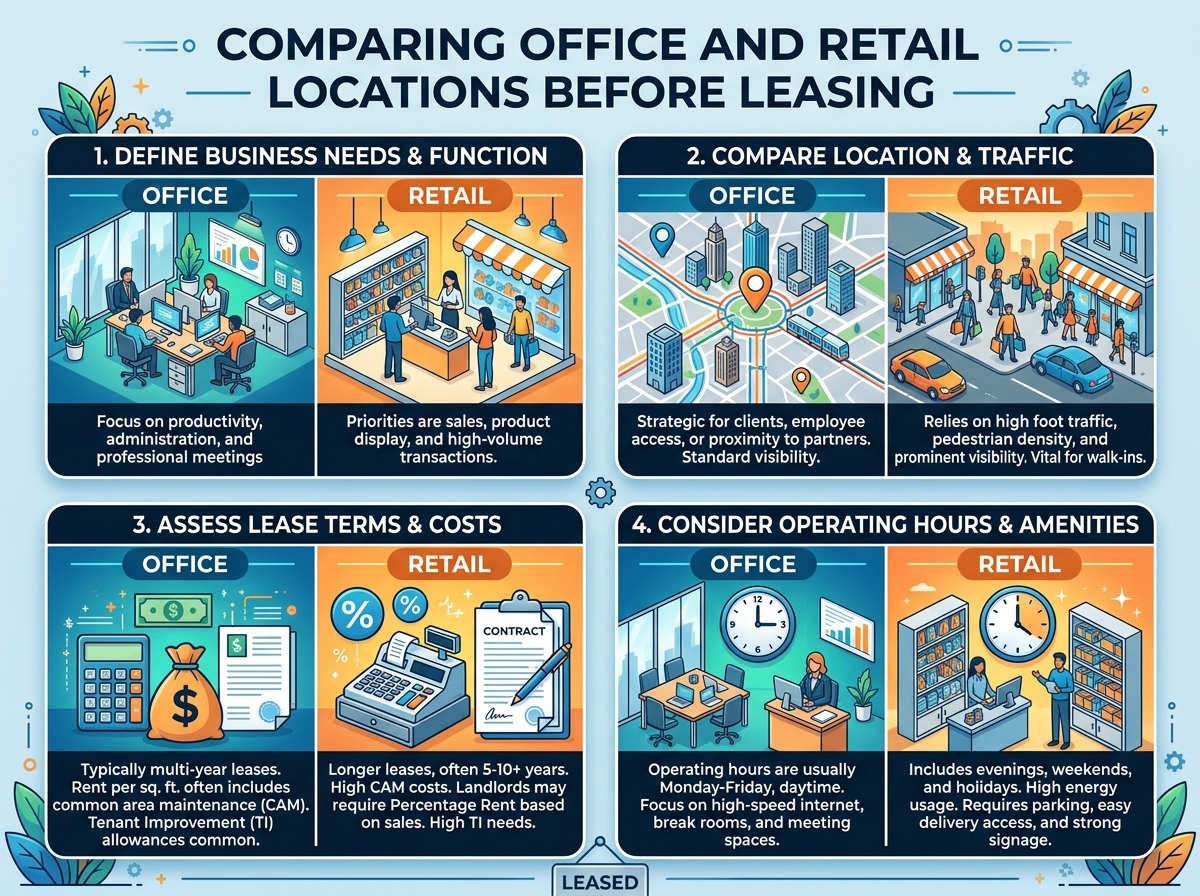
Begin with the business model rather than the most attractive listing. Identify how many employees, customers, vendors, and deliveries the location must accommodate each day. Account for private rooms, meetings, inventory, equipment, storage, restrooms, and circulation space. Also, decide whether the location should support growth during the next three to five years or simply solve a short-term need.
A small consulting firm may prioritize quiet meeting rooms, dependable internet, and transit access. A retailer may instead place the greatest value on storefront exposure, foot traffic, customer parking, delivery access, and display space.
2. Compare Office and Retail Space Differently
Office space should make work easier. Review employee commute patterns, nearby transit, parking, after-hours access, security, natural light, noise control, conference areas, and telecommunications capacity. A productive office need not be extravagant, but it should reliably support focused work and client visits.
Retail space must help customers find, enter, and use the business. Evaluate street visibility, storefront width, windows, signage rights, pedestrian flow, vehicle access, nearby tenants, loading areas, waste handling, and storage. Visit the area during morning, lunch, evening, and weekend periods to see how traffic, lighting, noise, and parking actually change.
Photorealistic view of a small modern commercial storefront and adjoining office space at golden hour, warm sunlight highlighting the entrance, windows, signage area, and inviting interior, with soft shadows and a thoughtful, professional atmosphere.
3. Calculate the True Occupancy Cost
Compare the estimated monthly cost and the full cost over the initial lease term. Include base rent, common area maintenance charges, property tax and insurance pass-throughs, utilities, janitorial services, technology fees, parking, security, moving costs, legal review, permits, furniture, and tenant improvements. Ask for operating expense history and projected increases rather than relying on a single quoted number.
A lower starting rate can become the more expensive choice if annual escalations are steep or the suite requires substantial renovation. Model a conservative scenario that includes higher utility use, delayed construction, and expenses not covered by the landlord.
4. Check Measurements and Layout
Request both rentable and usable square footage, along with the method used to measure the space. Rentable area can include a share of common building areas, while usable area is closer to the space available for the tenant’s daily operations. Review a scaled floor plan before final negotiations.
Questions to Ask About the Layout
- Will desks, fixtures, displays, inventory, and customer paths fit comfortably?
- Do columns, hallways, mechanical rooms, or oddly shaped walls reduce efficiency?
- Is there enough storage, receiving space, and room for future changes?
- Can the suite be expanded, divided, or reconfigured later?
5. Review Location, Access, and Visibility
Location is an operating tool. Office tenants should consider employee access, visitor convenience, transit, parking, and nearby services. Retail tenants should assess whether customers can see the business from likely approaches, park or arrive by transit, and enter without confusion. Confirm delivery routes, loading rules, elevator access, and any planned street or building construction that could affect operations.
6. Inspect Building Systems and Build-Out Needs
Finishes can hide costly problems. Review HVAC capacity, electrical panels, plumbing, drainage, internet infrastructure, fire and life-safety systems, windows, doors, roof conditions, elevators, and freight access. Document existing damage with dated photographs and written notes before possession.
Then estimate the full build-out scope: walls, flooring, lighting, electrical work, plumbing changes, HVAC modifications, signage, security, furniture, fixtures, permits, and professional design fees. If the landlord offers a tenant improvement allowance, clarify what it covers, who controls the work, when reimbursement occurs, and who pays cost overruns.
7. Review Lease Terms and Complete Due Diligence
A commercial lease sets the rules for operating the business. Review permitted use, term length, renewal options, rent increases, operating expense calculations, repair duties, insurance, personal guarantees, signage, operating hours, assignment and subleasing rights, restoration obligations, default provisions, and exit options. Every promise made during negotiations should be written into the lease or an exhibit.
Before committing, confirm zoning, licensing, certificate-of-occupancy requirements, building rules, signage restrictions, and required permits. Eligible New York City businesses can seek help signing a new commercial lease through a city legal-assistance program, but tenants in every market should consider qualified legal and real estate advice.
Customer-facing businesses should also evaluate entrances, routes, service counters, restrooms, and planned alterations against accessibility duties for businesses open to the public. Addressing these issues during site selection is usually easier than discovering them after construction starts.
8. Create a Comparison Scorecard
A scorecard reduces the influence of a great first impression. Score each location out of 100 points using categories that reflect the business priorities:
- Financial fit: 25 points
- Location, access, and visibility: 20 points
- Layout and usable space: 15 points
- Build-out requirements: 15 points
- Lease flexibility: 10 points
- Building systems: 10 points
- Future growth potential: 5 points
A retailer may place greater weight on visibility and customer access, while a professional firm may prioritize privacy, employee experience, and technology. The best space is not necessarily the newest, largest, or cheapest. It is the one that supports the business model, budget, customers, employees, and future plans without creating avoidable constraints.