Choosing a new fishing rod can feel overwhelming when you are staring at a wall of graphite, fiberglass, and composite options. You know that the right rod makes casting easier, improves sensitivity, and helps you land more fish. But with so many lengths, powers, and actions available, where do you actually start? The frustration usually comes from not knowing which specific specifications match your fishing style. This article breaks down the selection process into clear, practical steps. We will cover how to match a rod to your target species, interpret confusing terminology like power and action, and avoid the common pitfalls that lead to wasted money. By the end of this fishing rod guide, you will have the confidence to pick a rod that feels like a natural extension of your arm rather than a compromise.
Key Takeaways
- Match rod length and power to your specific fishing environment, not just the size of the fish you are targeting.
- Rod action determines where the rod bends, which directly impacts casting distance and hook-setting speed.
- Your choice of fishing line and lure weight must fall within the rod’s listed ratings for optimal performance and to prevent breakage.
- Consider the rod’s material and handle quality as key factors for long-term durability and sensitivity, not just the brand name.
- Specific regional conditions, such as heavy vegetation or strong currents, should heavily influence whether you choose a fast-action or moderate-action rod.
Understanding Your Fishing Environment First
Before you even look at a rod’s color or brand, you need to analyze the water you plan to fish. A rod that is perfect for a wide-open lake is terrible for a narrow, tree-lined creek. Ask yourself where you will spend the majority of your time. Are you casting from a boat in deep water, or are you wading in shallow flats? Are you fishing from a pier with heavy tackle, or are you skipping lures under overhanging branches?
Your environment dictates the necessary casting distance and accuracy. For example, if you are fishing in tight cover like mangroves or docks, a shorter rod between 6 and 6.5 feet gives you the leverage to make precise, short casts. Conversely, if you are surf fishing or casting spoons across a wide river, you need a longer rod—typically 9 feet or more—to generate the line speed required to launch heavy weights distances. Understanding these spatial constraints is the first step, and finding a specific resource to verify your choice for the state of Florida is often helpful. If you are planning a saltwater trip, this fishing rod guide explains how to match equipment to those specific coastal conditions.
Decoding Rod Power vs. Rod Action
The two most confusing terms for beginners are “power” and “action.” People often use them interchangeably, but they mean very different things. Power refers to the rod’s overall lifting resistance, often classified as ultra-light, medium, medium-heavy, or heavy. Action refers to where the rod flexes along the blank. You need to understand both to choose effectively.
What Does Rod Power Mean for Your Catch?
Power is all about the amount of force required to bend the rod. It determines the weight of the lure you can cast and the size of the fish you can control. If you are targeting panfish or trout, a light or ultralight power rod allows you to feel the lightest bite and provides a fun fight. If you are wrenching bass out of heavy lily pads or fishing for catfish on the bottom, you need a heavy power rod to pull the fish out of the vegetation.
- Ultralight: Best for crappie, trout, and small panfish.
- Medium-Light: Great for walleye and smallmouth bass.
- Medium: The versatile choice for largemouth bass and stripers.
- Medium-Heavy: Ideal for frogging, jigging, and fishing around heavy cover.
- Heavy: Used for musky, salmon, and large saltwater species.
Why Rod Action Dictates Your Hook Set
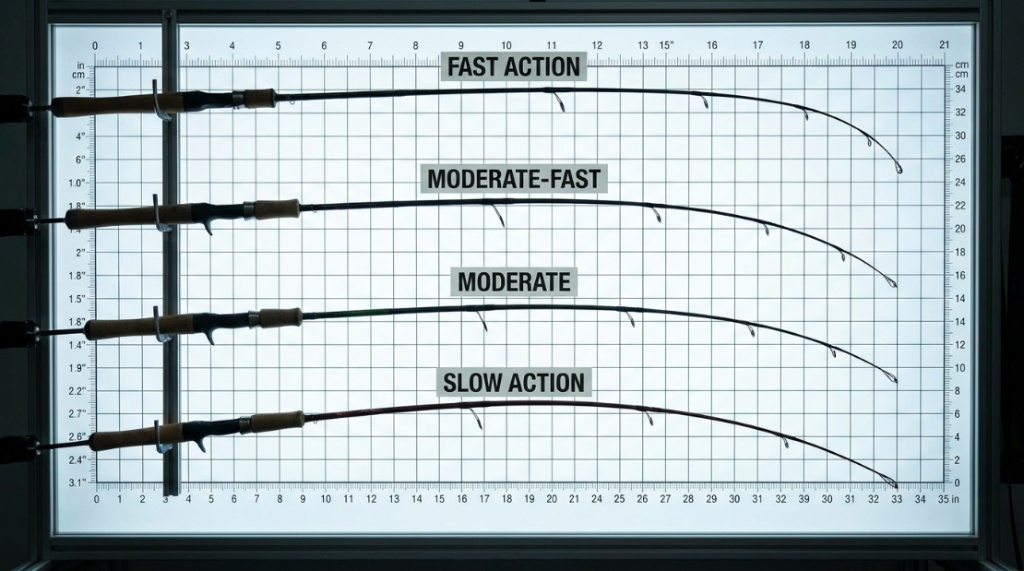
Action describes the bend profile. A fast-action rod bends mostly near the tip, while a slow-action rod bends deep into the lower half of the blank. Fast-action rods are incredibly popular because they offer excellent sensitivity and allow for an immediate hook set. When a fish strikes, the stiff backbone transfers your motion instantly to the hook. This is critical when fishing soft plastic baits where you must set the hook quickly to avoid the fish spitting the lure.
Moderate and slow actions, however, are not inferior. They are better for casting lighter lures because the rod loads deeper, acting almost like a slingshot. They are also forgiving with treble-hook lures like crankbaits. A fast-action hookset can rip a treble hook out of a fish’s mouth, whereas a moderate-action rod absorbs the shock, keeping the bait pinned during a long fight.
How to Match Lure Weight and Line Rating
Every rod has printed specifications near the reel seat or on the blank. These indicate the optimal lure weight range and the recommended line test. These numbers are not arbitrary suggestions; they are engineering guidelines based on the rod’s strength and taper. Ignoring these ratings is one of the most common mistakes anglers make, To maximize your catches on your next outing, check out our guide on the best artificial lures that fool gar every time.
When you cast a lure that is heavier than the rod’s maximum rating, you risk casting fatigue and can actually create a “hinge” effect where the rod bends improperly, causing it to fracture at the ferrule or handle. Similarly, using a line that is too heavy for the rod means that if you snag a log, the line will not break before the rod does. The rod is designed to break before the line if the drag is locked down.
Check the lure rating carefully. If you are throwing 3/8-ounce spinnerbaits, look for a rod rated for 1/4 to 3/4-ounce lures. This places your presentation in the sweet spot where the rod loads optimally for distance and accuracy. If your line is a 10-pound test, look for a rod that lists an 8- to 17-pound line rating. Staying within these spec windows preserves the rod’s action and protects it from breakage.
The Material Debate: Graphite vs. Fiberglass vs. Composite
Your budget and style of fishing will guide your material choice. Graphite rods are lightweight, incredibly sensitive, and transfer vibrations from the bottom structure to your hand better than any other material. However, graphite can be brittle. If you are a boater who tends to slam rod tips on the ceiling or a bank angler who frequently trips, graphite may snap during high-stress situations.
Fiberglass rods are much heavier but nearly indestructible. They have a slower reflex and are excellent for fighting hard-pulling fish that make aggressive runs. These rods are forgiving and help absorb the shock of a fish turning suddenly. Fiberglass is often used for musky rods or heavy catfish rods where durability outweighs the need for finesse sensitivity.
Composite rods blend the two materials. They usually feature a graphite core wrapped with fiberglass, offering a balance of moderate sensitivity and durability. Composite rods are excellent for all-around anglers who want a single setup for crankbaits and topwater lures without worrying about every nick or scrape. If you have to choose one rod for a weekend trip and cannot afford high-end graphite, a composite rod will serve you best.
Matching the Reel Seat and Handle Ergonomics
Many anglers check the rod blank but forget the handle, which is your primary physical connection to the tackle. The reel seat must fit the reel foot securely. Inexpensive plastic reel seats often loosen over time, causing the rod to spin while fighting a fish. Upgrading to a rod with a hooded stainless steel or anodized aluminum reel seat ensures your $200 reel stays locked in place.
Handle length also matters. For two-handed casting or long-distance surf fishing, you need a longer rear grip to hold under your arm. For flipping and pitching bass jigs, a shorter trigger grip gives you precise control with one hand. Consider cork versus EVA foam grips. Cork is lighter and provides a warm feel, but it chips and compresses over time. EVA foam is heavier but impervious to weather and does not chip. Saltwater anglers should prioritize EVA foam because it does not absorb saltwater that can corrode the blank.
Regional Considerations and Local Species
Where you live drastically alters rod selection beyond just the size of the fish. In Florida, for example, the inshore environment is dominated by seagrass flats and mangrove shorelines. Anglers casting for redfish or snook need a rod that can cast a 5-inch paddle tail into the wind but also have enough backbone to turn a fish away from a dock piling. This often results in a 7-foot medium-heavy fast-action rod.
Conversely, a trout angler in the Rocky Mountains needs a 9-foot rod in a 4- or 5-weight to delicately present dry flies. The technical “loading” of the rod is entirely different. Clear water requires leaders that are thin and fragile, so a slow action rod is necessary to protect those light tippets during the cast.
Consider also the water depth. Deep vertical jigging requires a short, heavy rod with a fast taper to detect subtle bites at 100 feet. A rod with too much flex will absorb the bite and you will miss the strike entirely. Match the rod to the tactic, not just the fish species.
Common Mistakes to Avoid When Buying a Rod
There are several recurring pitfalls that can ruin the excitement of a new purchase. Being aware of these will save you money and frustration on the water.
- Buying too heavy: Many beginners think a heavy rod is necessary to land big fish. If the rod is too stiff, you will rip the hooks out of smaller fish and lose the joy of feeling the fight.
- Ignoring the grip length: Casting a rod with a handle that is too short will hit your forearm on every cast, causing blisters and inaccuracy.
- Choosing a multi-piece rod for the wrong reason: Travel rods are convenient, but more ferrules mean more potential weak points. If you are not traveling, a one-piece rod is always structurally superior in sensitivity.
- Overpaying for brand names: A $150 rod from a known brand is often identical to a $100 rod from a lesser-known manufacturer. Look at the warranty and component quality, not just the sticker on the blank.
Budget Allocation: Where to Spend vs. Save
Your budget should be allocated based on how the rod will be used. If you are a shore angler casting heavy metal lures, you are likely to bounce the rod off rocks and gravel. In this case, do not spend hundreds on a high-modulus graphite rod. Buy a durable composite rod in the $60–$80 range. The action will be slower, but the durability is worth it.
If you are a tournament bass angler who needs to detect subtle bites on a shaky head at 30 feet, the sensitivity difference between a $100 rod and a $250 rod is substantial. High-end graphite rods use more advanced resin systems that transmit vibration faster. When you are fishing for dollars, that sensitivity is a worthwhile investment.
Check the warranty before you lose the receipt. Many high-end rods offer a 5-year or lifetime warranty that covers breakage during normal use. While the initial outlay is higher, the replacement cost is often just a shipping fee. Low-cost rods usually have no warranty, so the entire cost is lost on the first break.
Testing the Rod Before You Buy
Just because a rod has good reviews online does not mean it fits your body mechanics. You should visit a physical store to test the rod’s balance. Balance is tested by resting the rod on your index finger just in front of the reel seat. If the rod tips forward, it is tip-heavy. Tip-heavy rods cause wrist fatigue because you must constantly work to keep the tip elevated.
Casting a rod inside a store is awkward, but you can still perform a “grip test.” Hold the rod as you would while fishing and make a few mock casting motions. Notice if the reel seat feels small in your hand or if the trigger grip digs into your middle finger. Pay attention to the weight; a rod advertised as “ultra-light” should feel airy, not heavy.
Bring the reel you plan to use. A heavy baitcasting reel changes the balance of an ultralight rod significantly. Testing without your reel gives you a false sense of balance. If the store staff will not let you attach your reel, look at the specification sheet to see if the rod lists the recommended reel size.
Seasonal Adjustments to Your Rod Choice
You might own one rod for all seasons, but you should be aware that seasonal changes affect fish behavior and location. In early spring, fish are cold and slow. They hold in deep water and require finesse presentations. A medium-light rod with a soft tip is invaluable for casting tiny jigs and minnows without tearing them off the hook. In the summer, fish chase fast-moving topwater baits; a stiffer fast-action rod allows you to work a walking bait aggressively.
In winter, many anglers downsize to panfish tackle because the bite is subtle. Keeping a second rod rigged with a lighter line is much easier than respooling your only rod in cold weather. Having multiple rods is not about being a gear hoarder; it is about having the right tool ready for the daily conditions.
Frequently Asked Questions
Is a longer rod always better for casting distance?
Not necessarily. While a longer rod increases the arc during a cast for more line speed, you also need the correct line weight and lure weight. If the lure is too light for the rod, the long rod cannot load properly, and you will cast shorter distances. You must balance rod length with the lure weight.
Can I use a baitcasting rod with a spinning reel?
You can physically attach a spinning reel, but the guide eyes are positioned differently. Baitcasting rods have smaller eyes closer to the blank, which restricts line flow on a spinning reel. This leads to massive wind knots and poor casting. Always match a rod to the reel type it was designed for.
How do I know if a rod is broken if it has no visible cracks?
If the rod feels “soft” or bends dramatically at a single spot instead of a smooth curve, the blank might be structurally broken inside. Run your fingers along the blank; if you feel a slight depression or flat spot, the graphite fibers are crushed and the rod will fail under pressure.
What is the best action for topwater fishing?
Use a fast action rod for walking lures like spooks. The stiff tip allows you to execute quick twitches that make the bait dart side-to-side. A flexible rod ruins the action of walking baits because the tip lags behind your wrist movements.
Do carbon fiber rods really make a difference for beginners?
Carbon fiber rods are lighter and highly sensitive, but they are not necessary for a beginner. Beginners often make casting mistakes that result in the rod hitting trees or boat rails. A durable composite rod will teach you the casting basics without breaking. Move to carbon fiber once you have mastered the mechanics.
Conclusion
Choosing the right rod is a balance between science and personal feel. You now understand that power dictates lifting strength, action dictates bending and hook-setting, and length dictates casting reach. More importantly, you know that these specs must align with your environment—whether that is a river, a lake, or the saltwater flats. Material choice, handle ergonomics, and lure rating are not afterthoughts; they are foundational to your success and comfort. Do not rush the purchase. Take note of the species you target most often and the size of the water you fish. When you finally step onto the water with a rod that accurately transmits the lure’s action and the substrate beneath you, you will immediately notice the difference. Approach your next trip with this knowledge, and make a selection that helps you spend less time untangling and more time fighting fish.