Key Takeaways
- Useful keepsakes are more likely to remain part of a recipient’s routine than disposable giveaways.
- The strongest choices balance function, comfort, visual clarity, and connection to the event.
- Audience needs should guide the item, size, finish, and message.
- A simple design with one clear memory cue is often more effective than a crowded layout.
- Early proofing, sampling, and distribution planning can prevent avoidable problems.
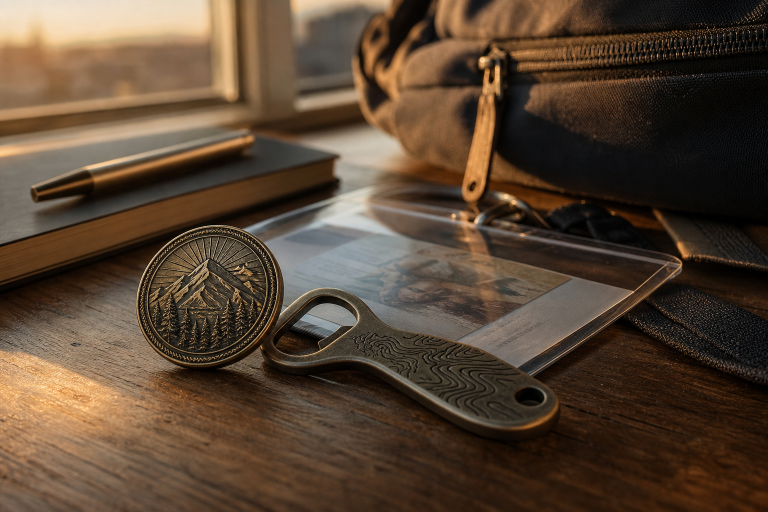
Event keepsakes are most effective when they do more than mark attendance. They should give people a small, useful reminder of a shared experience, whether that experience was a conference, fundraiser, reunion, tournament, ceremony, or volunteer day. Items such as bottle opener challenge coins can pair a familiar everyday function with an event-specific design, making the memento easier to keep in circulation after the event ends.
A novelty item may attract attention for a moment, but a practical keepsake can earn a place in a desk drawer, on a key ring, in a travel bag, in a vehicle, or in a kitchen. The goal is not to add another object to someone’s collection. It is to choose a useful form that carries a clear memory cue and feels worth holding onto.
Why Practical Keepsakes Work
Practicality gives a keepsake repeated chances to be noticed. Each use can bring back the event, the people involved, or the reason it mattered. A recent look at event marketing and brand recall also highlights the value of merchandise that extends engagement beyond the event itself. Utility alone is not enough, but utility creates a reason for the item to stay nearby.
A well-chosen keepsake can solve a small daily problem, prompt conversation, recognize participation, or communicate appreciation. That makes it especially suitable for groups that want to create a lasting impression without relying on a large or elaborate gift.
Start With The Audience
Begin with the recipient rather than the product catalog. Outdoor volunteers may appreciate something compact and durable. Conference guests may prefer an item that fits easily into a bag. Alumni, first responders, wedding guests, sports fans, and honorees may respond to different levels of formality, symbolism, and display value.
Questions To Ask Before Choosing An Item
- Who will receive it, and what does their day-to-day routine look like?
- Will they use it indoors, outdoors, while traveling, or at work?
- Should it feel formal, playful, rugged, minimal, or commemorative?
- Will recipients need to carry it during the event?
- Is the item intended for everyone, or for a smaller recognition group?
For a large gathering, a lightweight item that fits in a pocket or bag is usually easier to distribute. A heavier or more display-oriented keepsake can work better for a smaller ceremony where presentation is part of the experience.
Choose The Right Function
The function should feel natural, not forced. An item does not need several features to be worthwhile. One obvious use is enough if it suits the setting and is easy to understand quickly. Consider functions such as opening a common container, carrying keys or cards, supporting travel, identifying a role or achievement, or serving as a reminder on a desk, in a bag, or on a vehicle.
Use a simple test before approving the concept: can a recipient explain how they would use the item within a few seconds? If the answer is unclear, simplify the choice or select a more familiar form.
Build A Clear Design
Even a high-quality keepsake can lose impact when the layout tries to say too much. Start with one main symbol, image, or shape. Then add the event name, group name, or a short phrase. Include a date only when it adds meaning to the item, and reserve smaller details for a location, chapter, team, or milestone.
Color, edge detail, finish, raised elements, lettering, and cutout areas should all support the central idea. Before final approval, remove any visual element that competes with the main message. Readability at the finished size matters more than how the design looks when enlarged on a screen.
Balance Memory And Use
The most memorable items connect function to a specific story. That connection might come from a symbol recognized by attendees, a meaningful date, a local landmark, team colors, or a short phrase shared by the group. One detail that rewards a closer look can make an item feel personal without making it busy.
A keepsake does not need to summarize every speech, activity, or sponsor from the event. One strong memory cue is generally easier to recognize and more likely to remain relevant over time.
Plan For Quality And Comfort
Physical details influence whether recipients actually use an item. Check the final weight, size, texture, durability, and edge treatment. Lettering should remain readable, edges should feel smooth, and the item should fit naturally in its intended place. Request a digital proof, then inspect a physical sample when timing and budget allow.
Make The Design Easier To Use
Accessibility is part of good design. Strong contrast, uncomplicated shapes, readable type, and comfortable handling can make a keepsake more usable for a wider range of recipients. These choices also improve clarity for everyone.
Avoid Common Mistakes
- Using too much text or too many competing graphics.
- Choosing a function that does not suit the audience.
- Ignoring portability, weight, and comfort.
- Approving artwork before verifying spelling, dates, and placement.
- Prioritizing appearance while overlooking normal wear and handling.
- Ordering before confirming attendance estimates and backup needs.
The most common mistake is designing for the organizer instead of the recipient. Organizers may naturally focus on symbolism, while recipients may care most about whether the item is comfortable, understandable, and useful.
Create A Simple Production Plan
- Define the purpose: recognize, thank, commemorate, welcome, or connect.
- Identify the recipients and the intended use.
- Select one practical function and a clear design concept.
- Set a budget that includes production, packaging, shipping, and extras.
- Review the proof for accuracy, readability, size, and color.
- Order a sample when possible, then plan distribution responsibilities.
Current thinking about useful, well-designed merchandise emphasizes relevance, durability, and a clear purpose over simply increasing the number of items distributed. That is a helpful standard when making final tradeoffs.
Measure The Result
Success may mean appreciation, recognition, participation, or continued memory rather than immediate sales or online attention. Ask recipients whether they kept the item, whether they have used it, and what would make a future version better. Staff feedback can also reveal whether the distribution was smooth and whether the function was easy to explain.
Final Checklist
- Does the item fit the event and audience?
- Is its function immediately clear?
- Can recipients use it more than once?
- Is the design readable and centered on one memory cue?
- Are the size, weight, and edges comfortable?
- Have the artwork, timeline, budget, and delivery plan been checked?
Conclusion
Practical event keepsakes work when they feel personal, useful, and connected to a real moment. Keep the purpose clear, choose a function that fits the recipient, and let one thoughtful design detail carry the memory. A small item can have lasting value when people are genuinely happy to keep using it.