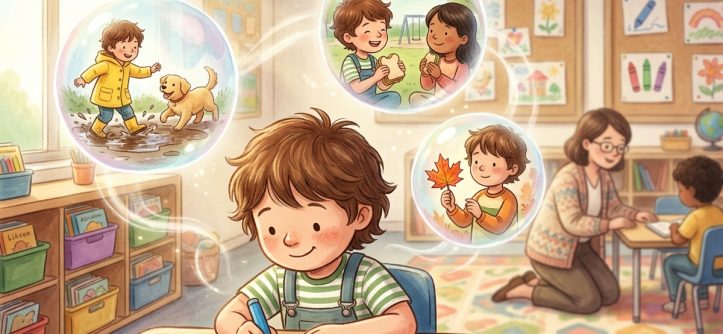
First graders do not need faraway adventures or complicated plots to become confident storytellers. A spilled bowl of cereal, a new puppy, a rainy recess, or a missing mitten can provide everything a young writer needs: people, actions, feelings, and an ending. Teachers can build on these familiar experiences with first-grade writing prompts and planning activities from experts at https://studentreasures.com/teachers-lounge/lesson-plans/first-grade/ that make getting started feel manageable.
The goal is not to produce perfect spelling or long pages of text. The goal is to help children choose one moment, recount it in order, and add enough detail so a reader can understand what happened. With a repeatable routine, young writers can learn that their own lives are full of worthwhile story ideas.
Why Everyday Moments Make Good Story Ideas
Familiar events reduce the pressure of inventing every part of a story. A child who writes about losing a lunchbox already knows the setting, the people involved, and the feelings that came with the problem. Small moments also naturally contain story parts: something begins, something changes, the writer responds, and the event ends.
Instead of asking, “Write about your whole weekend,” narrow the focus. “Write about the moment you saw the biggest puddle on Saturday” gives a child a clear starting point. That one moment might become: “On Saturday, I wore my yellow boots. I jumped into a muddy puddle. Water splashed on Dad. We laughed all the way home.”
Start With Speaking Before Writing
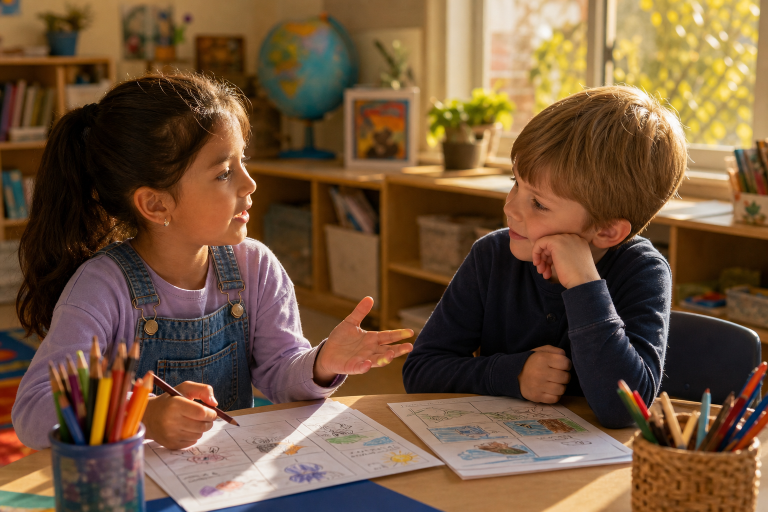
Many children can tell a story aloud before they can write it independently. Give students one minute to tell a partner about their chosen moment, then invite the partner to ask, “What happened next?” This brief conversation helps writers put events in order before facing a blank page.
Teacher modeling is useful here. Tell a short story aloud, thinking through questions such as “Who was there?” “What happened first?” “What changed?” and “How did it end?” Picture prompts, classroom objects, and turn-and-talk routines can also help students who say they have no ideas. Speaking first is especially helpful for children whose ideas move faster than their pencils.
Use A Simple Story Map
A simple story map keeps first graders focused on one event rather than listing everything they remember. Use five labeled boxes, and let students draw, write a word, or dictate an idea in each one:
- Setting: Where and when did it happen?
- Characters: Who was there?
- Beginning: What started the event?
- Middle: What action, problem, or surprise happened?
- Ending: How did the event finish?
For a missing-lunchbox story, a student might draw the cafeteria as the setting, write “Ms. Lee and me” as the characters, and sketch the lunchbox waiting in the classroom for the ending. The map does not need to be polished. Its purpose is to give the child a path from idea to draft.
Help Students Add Clear Details
Details help a reader picture the story. Compare “I saw a dog” with “I saw a wet, brown dog shaking water by the gate.” The second sentence tells the reader more without making the sentence difficult to understand.
Invite children to notice what they saw, heard, felt, smelled, or touched. Keep a small word bank nearby with words such as bright, noisy, cold, soft, muddy, sweet, tiny, and bumpy. A quick game can build this habit: place an object in a bag, let students feel it, and ask them to describe it without naming it. Their describing words can become story words later.
Turn Ideas Into Strong Sentences
Sentence building becomes less overwhelming when it follows a predictable sequence:
- Name the person, place, or thing.
- Choose an action word.
- Add one helpful detail.
- Check for a capital letter and an ending mark.
Sentence starters can give hesitant writers a launch point while still leaving room for original ideas. Try “One morning, I noticed…,” “At first, everything seemed…,” “Then something surprising happened…,” or “By the end of the day….” Encourage students to use the starters only when they help. The real goal is a connected story, not a worksheet full of unrelated sentences.
Support Different Learners
Adjusting support does not mean lowering the assignment’s purpose. Some students may begin with picture cards, a labeled word bank, shared writing, teacher scribing, or speech-to-text. Others may need time to draw the whole event before adding labels and sentences. Multilingual learners can first plan in the language that helps them express the idea most fully, then receive support in building English sentences.
Students ready for more can add dialogue, explain a character’s feeling, write a more surprising ending, or retell the same event from another person’s point of view. Every child can work toward communicating a clear beginning, middle, and ending.
Revise One Small Part At A Time
Revision should feel like clarifying a story, not like being punished for mistakes. Ask children to review one feature at a time: Does the story stay on one topic? Can the reader tell what happened first? Is there one detail that helps the reader imagine the scene? Does the ending make sense?
A student-friendly checklist can use symbols, such as a house for setting, a clock for order, an eye for detail, and a star for an ending. Structured modeling and planning routines have received renewed attention in elementary writing instruction, including reporting on teaching students how to write through explicit strategies. Peer feedback can remain simple: one compliment and one helpful question.
Give Students A Real Audience
Children often revise more willingly when they know someone will hear their work. Create a reading circle, hallway display, class story collection, family reading day, or audio-recording station. Students can share writing that includes invented spelling, drawings, labels, and dictated sentences because each format communicates an idea.
Celebrating finished work also shows children that stories can take many forms. The 2026 young writers’ stories demonstrate how children can combine original writing and illustrations to present meaningful ideas for an audience.
Common Questions About First-Grade Story Writing
How Long Should A First-Grade Story Be?
Length should match the child’s development and the lesson goal. A few connected sentences with a clear event, useful detail, and understandable ending can show strong growth.
What If A Student Says, “I Have Nothing To Write About”?
Offer a personal photo, a classroom object, a favorite read-aloud, or a choice board. Ask about a recent surprise, celebration, challenge, or discovery.
Should Teachers Correct Every Spelling Error?
Choose a small number of high-value corrections, such as a familiar word, spacing, or ending punctuation. Too many marks can distract from the story the child worked to communicate.
How Can Families Help At Home?
Families can ask a child to tell one story from the day, ask one follow-up question, and help the child write one sentence or draw one important scene.
How Can Progress Be Measured?
Track growth over time by noticing whether a student stays on topic, organizes events, adds details, writes complete sentences, and revises with support.
Final Thoughts
Strong first-grade stories often start with ordinary moments that matter to the child. Conversation, simple planning, clear details, sentence practice, and gentle revision give young writers structure without taking away imagination. When students see that their experiences belong on the page, writing becomes a skill they can practice with confidence.