Key Takeaways
- Control temperature, humidity, airflow, and electrical conditions for reliable results.
- Define clear test goals, measurements, and safety stop conditions.
- Monitor for overheating, gas release, fire, and thermal runaway.
- Use calibrated equipment and consistent data recording.
- Match fixtures and procedures to the battery format and risk level.
- Follow relevant safety standards and emergency procedures.
Battery testing is most useful when results are repeatable, comparable, and gathered without exposing people or equipment to unnecessary risk. A properly selected battery test chamber helps teams control critical conditions and evaluate cells, modules, and packs under realistic operating conditions. Whether the goal is product development, incoming quality checks, certification preparation, or failure analysis, safety and data quality should be planned together. The test environment, electrical profile, monitoring approach, and emergency procedures all influence what a result actually means.
Why Controlled Testing Matters
Controlled testing reduces unwanted variation, making it easier to compare samples and identify meaningful trends. Temperature, humidity, airflow, charge rate, and rest time can all change battery behavior. For example, the same lithium-ion cell may show lower available capacity and higher resistance during a cold test than at room temperature. Repeatable conditions support design decisions, production checks, and credible safety reviews.
Key Environmental Conditions To Control
Temperature is often the first variable to define because cold starts, heat exposure, thermal cycling, and high-temperature aging can affect performance and degradation. Humidity control matters when moisture, corrosion, or condensation could affect samples, fixtures, or instrumentation. Consistent airflow helps prevent localized hot spots, while appropriate ventilation and pressure relief are essential when tests could produce gases. Finally, match test duration to the question: short runs may show immediate performance, while extended cycling can reveal aging, drift, and failure patterns.
How To Build A Battery Test Plan
- Identify the battery chemistry, format, capacity, condition, and intended application.
- Define the objective, such as capacity, power, cycle life, thermal behavior, or abuse response.
- Set environmental conditions, charge and discharge profiles, sample quantity, and rest periods.
- Specify measurements, including voltage, current, temperature, time, and any gas or pressure data.
- Establish stop conditions for abnormal readings, smoke, swelling, or loss of control.
- Run a lower-risk pilot test, then document deviations before beginning the full sequence.
Common Battery Testing Risks
Common hazards include overheating due to high current or damaged cells, short circuits caused by poor connections, gas release, fire, rupture, and thermal runaway during abuse testing. Closed spaces can also create hazardous pressure buildup, while failed sensors or loose electrical connections can compromise both safety and records. Recent research on thermal runaway also highlights why chamber response, venting paths, door restraint, and early warning methods deserve attention when evaluating larger-format cells.
Safety Controls Every Lab Should Review
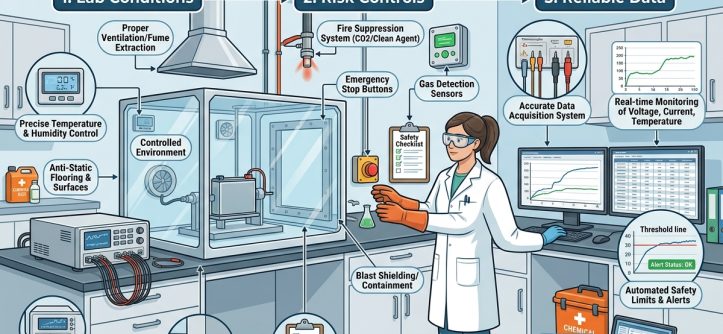
Effective protection uses layers rather than relying on one alarm or procedure. Monitor temperature, voltage, current, smoke, and gases when the test risk warrants it. Configure automatic shutdowns for approved limits, use appropriate containment barriers and fixtures, and provide a planned route for pressure and gases to leave the test area safely. Maintain ventilation systems, inspect interlocks and wiring on schedule, and train staff on alarm response, evacuation, isolation, and incident reporting.

How Test Conditions Affect Data Quality
Poor control can create misleading conclusions. Small temperature shifts may affect resistance, capacity, charge acceptance, and apparent aging. Use calibrated instruments, place sensors so they accurately represent the sample, and record the complete test profile rather than only the final values. Repeated runs help reveal equipment drift and sample-to-sample variation. Clear naming rules for cells, fixtures, channels, runs, and data files also make results easier to trace and review.
Testing Different Battery Formats
- Cylindrical cells: Prioritize holder fit, consistent contact pressure, and even cooling.
- Pouch cells: Account for swelling, tab protection, compression requirements, and surface temperature measurement.
- Prismatic cells: Plan for greater mass, rigid enclosures, and heat movement through the case.
- Modules: Review electrical isolation, balancing, monitoring access, and fixture design.
- Battery packs: Allow for higher stored energy, larger conductors, cooling systems, and emergency access.
Battery Testing Lab Planning Checklist
- Confirm electrical capacity, circuit protection, grounding, and emergency shutoff access.
- Review floor loading, sample movement routes, door clearances, and service space.
- Plan heating, cooling, humidity control, exhaust, data storage, and network access.
- Separate routine performance work from higher-risk abuse testing whenever practical.
- Document emergency contacts, operating procedures, maintenance schedules, and staff training.
- Leave room for added test channels, larger samples, and future monitoring needs.
Standards And Industry Guidance
Test teams should review the standards that apply to their product, market, chemistry, and use case. Requirements may address cells, modules, packs, vehicles, or stationary storage systems, with methods covering performance, environmental exposure, electrical abuse, and fire propagation. Confirm the current edition before finalizing a procedure. Lessons from large-scale battery fire testing can also inform risk reviews for energy storage projects and facility planning.
Common Questions About Battery Testing
What Is The Main Goal Of Battery Testing?
Testing can measure capacity, power, cycle life, reliability, thermal behavior, and safety response under defined conditions.
Why Does Temperature Matter So Much?
Temperature changes resistance, available capacity, charging behavior, and aging rate, so it must be measured and controlled carefully.
When Is Humidity Control Needed?
Humidity control is important when moisture, condensation, corrosion, or environmental exposure could affect the battery, fixture, or instruments.
What Should Be Monitored During A High-Risk Test?
Monitor voltage, current, temperature, smoke, gas, pressure, visual changes, and automatic stop signals appropriate to the hazard.
Can One Setup Handle Every Battery Format?
Usually not. Size, stored energy, electrical load, fixture requirements, cooling needs, and risk level can require different equipment and procedures.
Conclusion
Strong battery testing programs begin with clear goals and stable conditions, then support both with layered safeguards and disciplined data capture. By reviewing procedures regularly, maintaining equipment, and planning for abnormal events before testing starts, teams can make more reliable decisions and identify problems earlier. Consistent monitoring of temperature, voltage, current, and other relevant conditions also helps researchers understand battery performance and detect unexpected changes. Well-documented results make it easier to compare samples, identify trends, and improve future testing. A thoughtful approach balances performance evaluation with safety, helping teams build confidence in battery designs while reducing unnecessary risks during development, quality checks, and certification preparation.